
The Complete RV Checklist: Pre-Trip, On-Site, and Post-Trip
A comprehensive RV checklist organized by scenario rather than by system. Pre-departure, arrival, on-site, departure, and post-trip workflow with the community wisdom mainstream checklists miss.
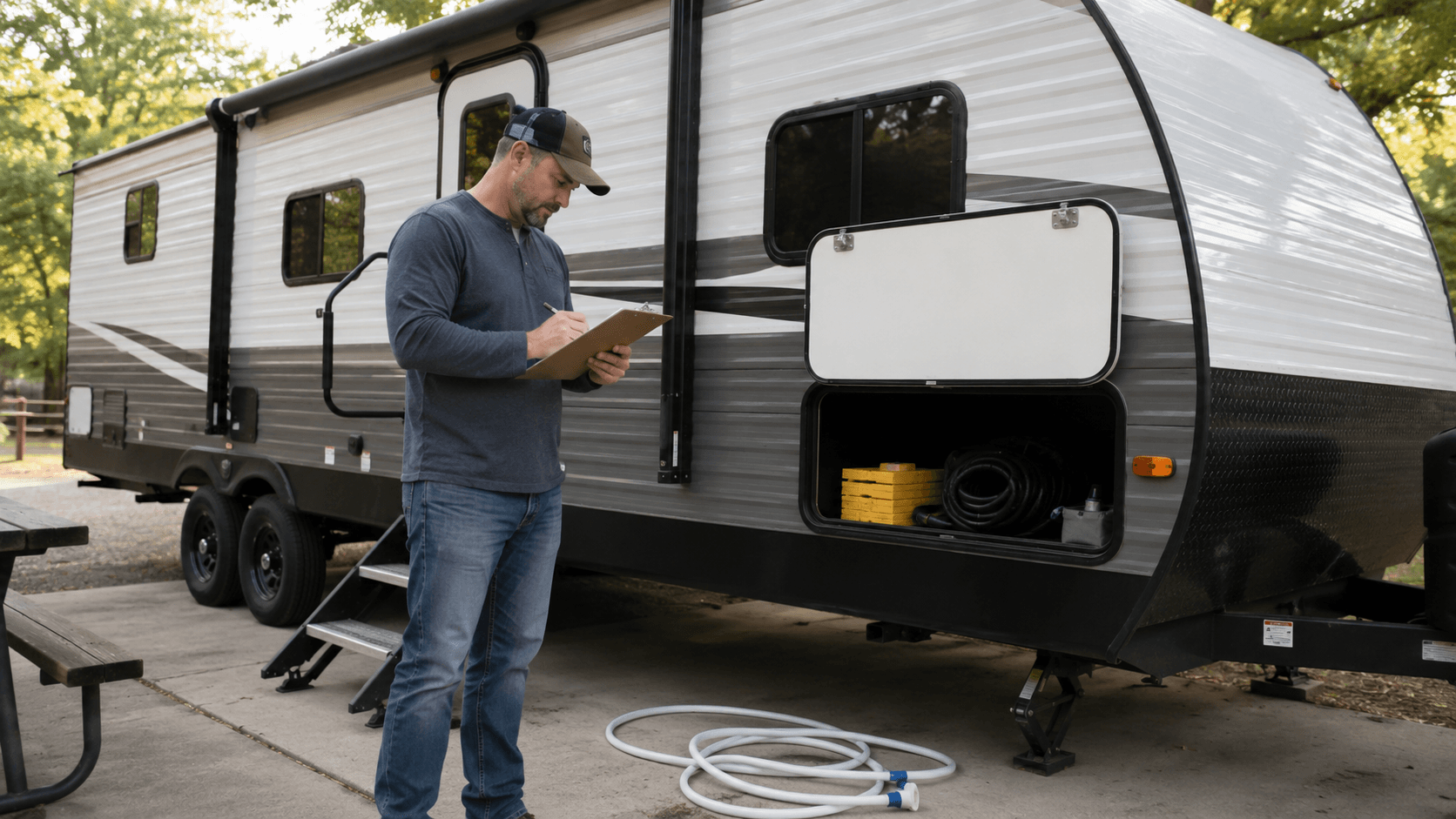
The difference between a good RV trip and a bad one is almost always something that could have been caught on a checklist. The pre-departure step that got skipped. The roof seal that wasn't checked before the rain. The slide that wasn't secured before driving. The propane line that wasn't verified before the first cold night. The tire that was a few PSI low for three trips before it became a blowout on the interstate.
Experienced RV owners don't trust their memory for any of this. They use a checklist. Not because they're forgetful, but because the RV has too many systems to track without one, and the systems fail at the worst possible moments when something gets missed.
This is the complete RV checklist organized by scenario rather than by system. The reason for that organization is simple: when you're standing in your driveway about to leave on a trip, you don't want a list organized by system. You want a list organized by the moment you're in. The same applies when you're arriving at the campsite, when you're packing up to leave a site, when you're getting home, and when you're getting ready for the next season.
The checklist below covers all of those moments. It's comprehensive, which means it's long, but the structure lets you use just the section you need. Bookmark it. Print the relevant sections. Build it into a maintenance app. Whatever helps you actually use it.
Jump to a checklist: Pre-departure · Arrival at campsite · During the trip · Departure from campsite · Post-trip
Why a checklist matters
An RV is a building on wheels. It has a propane system, a 120V AC electrical system, a 12V DC electrical system, a fresh water system, a grey water system, a black water system, a refrigeration system (often dual-mode), a heating system, a cooling system, a roof with multiple seals and penetrations, slides, awnings, batteries, tires that age in years not just miles, and a structural frame that flexes constantly during travel. Each system has its own failure modes. Most of those failure modes are preventable. None of them are obvious until they aren't.
The professional standard for RV safety is NFPA 1192, the National Fire Protection Association's Standard on Recreational Vehicles, which sets requirements for fire and life safety systems including propane handling, carbon monoxide detection, and electrical installation. The RV Industry Association maintains certification programs that verify manufacturers comply with NFPA 1192 and related standards. These standards govern how RVs are built; the checklist below covers how owners verify the safety-critical systems are still working as the rig ages.
The other reason a checklist matters is that RVs sit for long stretches between uses. Most household appliances are used daily, which means small problems get noticed quickly. An RV propane system that's worked fine for two years can develop a slow leak during storage and you won't know until the first appliance ignition. A roof seal that's lasted ten years can give out during winter storage and not announce itself until the next rain. The checklist is what catches those silent failures before they become loud ones.
Your RV is not exactly like anyone else's
Before the checklists themselves, an important note that most generic RV checklists never address: every RV is genuinely different, including from other RVs of the same brand, year, and model.
This is one of the realities that makes RV ownership genuinely harder than car ownership. A 2024 Honda Civic is built with the same components as every other 2024 Honda Civic of that trim level. RVs aren't built that way. An RV manufacturer building hundreds of units of the same model in a single year sources components from multiple suppliers, and the specific components installed in any individual unit depend on what was available when that unit went down the assembly line. Two RVs that came off the same factory line three months apart can have meaningfully different hardware inside.
A few common examples:
The water heater. Suburban and Atwood (now part of Dometic) are both major brands. A given model of RV might be built with either depending on supplier availability that month. The two brands have different anode rod requirements: Suburban water heaters use anode rods that need periodic replacement, while Atwood-style aluminum tanks do not. They have different controls, different burner orifices, and different service procedures. A checklist item that says "replace the water heater anode rod annually" is correct for one and incorrect for the other. Newer rigs may also have tankless on-demand water heaters from Truma, Girard, Lippert, Airxcel, or other suppliers, each with its own maintenance pattern.
The thermostat. Dometic, Coleman-Mach, and other brands all supply thermostats to RV manufacturers. The interface, programming, and operation differ enough that owner advice for one brand isn't always applicable to another.
The slide-out motor and mechanism. Lippert Components dominates this category, but Power Gear and other suppliers also supply slide systems. The maintenance points differ. The lubrication requirements differ. The way the slide reports faults differs.
The refrigerator. Dometic and Norcold have been the dominant suppliers for decades, with newer compressor-based units from various manufacturers entering the market. Two units of the same RV model can have different fridges with different troubleshooting paths.
The converter or inverter. The brand and model of the unit that converts shore power to 12V DC for the house systems varies. Some are simple converters; some are inverter-chargers with battery management features. The maintenance and troubleshooting are different.
The point isn't that you need to be an expert on every brand of every component. The point is that generic RV advice is necessarily generic, and your specific rig may need slightly different attention than the generic checklist suggests. Before you can use any checklist effectively, you need to know what's actually in your rig.
This means doing some homework once. Open compartments. Look at component labels. Note the brand and model of your water heater, your refrigerator, your furnace, your air conditioner, your converter or inverter, your generator if you have one, and your slide motors. Many of these labels are inside the unit; some require opening an access panel. The information is often not in the owner's manual the dealer handed you, because that manual is written for the model generally, not for the specific unit you bought.
Once you've documented what's actually in your rig, the generic checklists can be adjusted for accuracy. The Suburban water heater owner adds the anode rod check; the Atwood owner skips it. The Lippert slide owner uses Lippert's published maintenance intervals; the Power Gear owner uses theirs.
This is also what makes a dedicated maintenance app significantly more useful than a generic printed checklist. A printed list can't know what's actually in your rig. An app that researches your specific year, make, and model can do most of that homework for you, preloading the components your rig was built with so the schedule starts out matching the hardware in front of you instead of a generic RV that does not exist.
That's the philosophy behind how RVKeeper handles this. You give it your year, make, and model, it researches your rig and preloads what it finds, and you correct anything that does not match when you spot it. Generic advice gets replaced by accurate advice, and the plan keeps getting sharper the more you use it. We'll come back to the app at the end of the article.
A printable companion checklist
The article below covers the full pre-trip, on-site, and post-trip workflow in detail, organized by scenario. For owners who want a tangible, printable version they can keep in the RV or run through on a phone screen, a companion printable PDF checklist is available for download. The PDF condenses the structure below into a usable physical artifact with checkboxes you can tick off as you work through each section.
Download the printable RV checklist (PDF)
The article and the PDF cover the same territory. The article explains the reasoning behind each item; the PDF is the working tool you actually use in the driveway and at the campsite. Most owners find both useful: the article on the first read or two while they're learning the workflow, the PDF on every trip from then on.
The pre-departure checklist
This is the longest and most important checklist. It covers everything you should verify before you turn the key for any trip, whether you're going across town or across the country.
The structure below walks the rig in roughly the order most people do: tires first (because they're the most safety-critical), then exterior, then mechanical, then interior, then loading, then final readiness.
Tires (most important, do first)
- Check air pressure in every tire including the spare, against the pressure listed on the RV's data plate (not on the tire sidewall). Cold pressure is what matters; check before driving. The NHTSA tire safety guidance emphasizes that underinflation is one of the most common causes of tire failure.
- Inspect each tire visually. Look for cracks in the sidewall, bulges, embedded objects, or uneven wear patterns.
- Check tire age. Find the DOT date code on the sidewall (a four-digit number indicating week and year of manufacture). RV tires typically need replacement at 6 to 10 years regardless of tread depth because the rubber degrades from UV and ozone exposure.
- Check tread depth. The quarter test is workable for a quick check; if you can see Washington's head, the tire is at or below the legal minimum.
- Verify the lug nuts are tight. A torque wrench check at the manufacturer's specified torque value is best; visual inspection for missing nuts is the minimum.
- If you have an aftermarket tire pressure monitoring system (TPMS), confirm it's reading all sensors and that no warnings are active. Many experienced RVers consider TPMS a near-essential aftermarket upgrade because it catches slow leaks before they become blowouts.
- Check wheel chocks and leveling blocks are in their proper storage location.
Exterior walkaround
- Inspect the roof for visible damage, lifted seals, or debris. A thorough roof inspection is its own task and worth doing seasonally; the roof inspection guide covers what to look for. The pre-trip check is a quick visual scan.
- Verify all exterior compartments are closed and latched. Storage compartments left open are common road damage causes.
- Verify the steps are retracted.
- Verify the TV antenna is down. Crank-up antennas left up have killed many rig roofs against low overpasses, low-hanging trees at campsite exits, and even garage doors at home.
- Verify the awning is fully retracted and locked. Check that the awning lock pin is engaged if your awning has one; without the pin, the awning can deploy at highway speed and shred itself or damage adjacent vehicles.
- Verify slide-outs are fully retracted. Most slide systems have visual indicators for full retraction.
- Verify all roof vents are closed. This is one of the most commonly forgotten items. Roof vents left open during travel pull dust, debris, and (worst case) rainwater directly into the rig. The bathroom vent fan in particular often gets missed.
- Verify exterior lights work: marker lights, brake lights, turn signals, license plate light. Have a helper watch while you cycle through them, or use a reflective surface.
- Check the hitch (for trailers) or tow bar (for towed vehicles). Verify pin engagement, safety chain attachment, breakaway switch attachment, and that any sway control bars or weight distribution hardware is properly seated.
- Check the 7-pin trailer plug (for trailers) is fully seated and that the lights and brakes are responding through it.
Mechanical readiness
- Verify engine oil level (for motorhomes). Check coolant level. Check power steering fluid. Check brake fluid.
- Verify transmission fluid level (often checked with engine running and transmission warm; consult your manual).
- For diesel motorhomes, verify DEF (diesel exhaust fluid) level.
- For gas motorhomes and tow vehicles, verify fuel level. Plan fuel stops in advance; many RV-friendly stations are not at every interstate exit.
- Verify the battery is connected and the disconnect switch (if you have one) is in the right position.
- Verify the house batteries are charged. Voltage at rest should read approximately 12.6V for a fully charged 12V battery system.
- Adjust the rearview and side mirrors before pulling out of the driveway. Mirrors get bumped during loading and walk-arounds; the time to discover yours are out of position is in your driveway, not at highway speed.
Propane system
- Verify the propane tank or cylinders are filled to the level you need for the trip. Most RV tanks are filled to 80 percent capacity by safe-handling rules.
- Visually inspect the regulator and visible LP lines for damage, corrosion, or signs of leakage. NFPA 1192 governs the installation and inspection requirements for these components.
- If you have any reason to suspect a leak, do a soapy water test on connections before travel. Bubbles indicate a leak that must be repaired before any propane use.
Interior systems
- Pre-cool the refrigerator at least 12 hours before loading food. RV refrigerators take much longer to reach temperature than household fridges. Loading food into a warm fridge means it sits at unsafe temperatures while the fridge struggles to cool, and the fridge may never catch up if you also load while traveling. Run the fridge the day before, then load when it's cold.
- Verify the refrigerator is operating in your travel mode (12V DC for many newer units, propane for many older ones). The refrigerator troubleshooting guide covers what to do if it's not cooling right.
- Verify the refrigerator door is latched. RV fridge doors typically have a travel latch separate from the magnetic seal; if it's not engaged, the door swings open during the first hard brake.
- Verify the air conditioner runs (if you'll need it) and that the RV AC troubleshooting guide is bookmarked for the inevitable summer heat day when it doesn't.
- Verify the water pump runs and that the fresh water tank is at the level you need (or empty if you're traveling without water on board).
- Verify the toilet flushes and that black tank flush water is available if needed.
- Verify the LP-and-CO detector and smoke alarm are operational. Press the test button on each. NFPA 1192 requires these in every RV; replacement intervals are typically 5 to 10 years.
- Verify the fire extinguisher is present, charged (the gauge needle should be in the green zone), and accessible.
- Verify cabinet latches and refrigerator door catches are engaged. Items shifting during travel cause a lot of preventable damage.
Loading and securement
- Verify weight distribution. Heavy items should be low and centered, not stacked high or biased to one side. Overloaded axles are a common cause of tire failure and frame damage.
- Stay within your rig's Cargo Carrying Capacity (CCC) and towing capacity. These are listed on the rig's federal weight sticker and are worth knowing once; the everyday version of this item is just keeping the rig sensibly loaded.
- Secure any loose items inside cabinets. Use shelf liners, drawer latches, or simple foam blocks. The principle: anything that isn't secured is a projectile during a sudden stop.
- Pack zip ties. They're one of the most useful items in an RV. Securing a cabinet that won't quite stay closed, holding a loose hose in place, fixing a broken latch temporarily, securing the awning lock during travel. Carry plenty of them.
- Verify the TV (if you have one) is secured to its bracket and the antenna cable (if any) is disconnected before travel.
- Verify the awning rod, sewer hose, water hose, and other exterior gear are stored in their proper compartments.
- Place anything in the sink or shower (shampoo bottles, soap dishes, mugs) where it can't shift and accidentally activate the faucet. A tall bottle in the sink that tips during a sharp turn can land on the faucet handle and run water continuously for hours.
Final readiness
- Verify your route, fuel stops, and destination contact information. Many RV-specific GPS units route you around low clearances and weight-restricted roads; verify yours has current data.
- Verify your reservation at the destination if one is required.
- Verify the propane tank valve is in the closed position for travel. This is one of the most-debated topics in the RV community. Some owners leave propane on during travel to keep the absorption refrigerator running; others always travel with it off for safety. The safer default for any owner is OFF for travel: propane is required closed in many tunnels (most states), required closed when refueling, and a leak in transit is a serious hazard. If your refrigerator is dual-mode, switch it to 12V DC or electric for travel rather than leaving propane on.
- Verify pets are secured in the tow vehicle or motorhome with appropriate restraints. Towables should not be occupied during travel.
- Final walkaround. One more loop around the rig before you turn the key. Look for anything that's different from when you started: a compartment left open, a chock left in place, a power cord still connected, a step still down. This walkaround catches what every other step missed.
That's a long list. Most experienced owners can run it in 15 to 30 minutes once they've done it a few times. The first few times take longer because you're learning the rig. Build it into your routine and the time investment is small compared to what it prevents.
The arrival-at-campsite checklist
When you pull into your site, there's a sequence that makes the rest of the trip work. Skipping steps here is how people end up with broken hookups, water damage, or appliances that don't run when they're needed.
Position and verify before committing
- Position the rig where you want it before doing anything else. Once you're connected to utilities, moving even a few feet is a hassle.
- Before leveling, verify that your power cord, water hose, and sewer hose will all reach their respective connections from your chosen parked position. Discovering that the spigot is six feet too far away after you've already deployed leveling jacks is a hard-learned lesson, especially with shorter water hoses or sewer hoses on tighter sites.
- Verify there's room for your steps to deploy without hitting bushes, rocks, or uneven ground. Verify there's room for slides to extend on both sides without hitting trees, picnic tables, fire pits, or the neighboring site's gear.
- Test the pedestal before fully committing to the site. Plug in a basic outlet tester or surge protector with diagnostic lights. Open the spigot briefly to verify water is flowing and the connection is intact. Catching a dead pedestal or a non-functioning spigot before you've broken down setup gives you the option to request a different site.
Level
- Verify the rig is level enough for the refrigerator (absorption refrigerators specifically; compressor refrigerators are tolerant of significant tilt). Most absorption refrigerators tolerate roughly three degrees of tilt; beyond that, the cooling cycle stops working correctly.
- Deploy leveling blocks or use the integrated leveling system. Once the rig is level, chock the wheels before disconnecting from the tow vehicle (for trailers).
Utilities
- Connect shore power. Use an EMS (Energy Management System) at every pedestal. An EMS is a step up from a basic surge protector: it monitors voltage in real time, detects polarity issues, and disconnects the rig if power conditions become dangerous. A miswired pedestal can damage RV electronics within seconds; an EMS prevents that.
- Connect water. Use a pressure regulator at the spigot; many campgrounds deliver water at pressures that can damage RV plumbing. A 40 to 50 PSI regulator is standard.
- Connect the sewer hose if you have full hookups. Verify the connection is sealed and that you're connecting to the campground's sewer outlet, not a stray drain.
- Keep the black tank valve closed even when you have a full sewer connection. The temptation is to leave it open so waste drains continuously, but doing so lets liquids drain away while solids accumulate in the tank, building up the dreaded "poop pyramid" that's a nightmare to clean out. Keep the valve closed, let the tank fill to roughly two-thirds, then dump it all at once so the liquid carries the solids out.
- Grey tank valves can be left open on full hookup sites if you prefer, though closing them and dumping periodically works fine too. The pyramid issue is specific to the black tank.
Setup
- Extend slides slowly. This is one of the highest-stakes parts of campsite setup, and a place where a spotter genuinely matters. Have someone stand outside watching the path of each slide as it extends. If the slide is going to hit a tree, an awning, a picnic table, or anything else, the spotter can bang on the side of the rig to stop the slide before damage occurs. Slide damage from obstruction is one of the most expensive preventable mistakes in RV ownership.
- Deploy the awning if conditions allow. Awnings should be retracted whenever wind exceeds about 20 mph or when you're away from the rig for any length of time.
- Deploy the steps.
- Set up exterior gear: outdoor mat, chairs, table, grill location.
- For longer stays (more than a few days, especially in sunny climates), consider deploying tire covers. RV tires age primarily from UV and ozone exposure, not mileage. Tire covers during extended stays slow the rubber degradation that eventually retires tires before their tread is worn out.
Final arrival checks
- Verify the refrigerator is cooling correctly now that the rig is level.
- Verify the air conditioner or heat is running if needed.
- Verify the water heater is set to run on propane, electric, or both as you prefer. Most water heaters have separate switches for the two modes.
- Verify the fresh water tank is filling (if you're filling it for offgrid use later in the trip) or that you're running directly from city water pressure.
During the trip
A short daily-use checklist for active use of the rig. Most of this is preventive; the goal is catching small problems early.
Daily checks
- Walk around the rig once a day. Look for new signs of leaks (water stains, propane odor, exterior fluid drips), tire condition (especially after a long day of driving), and slide-out condition.
- Empty grey and black tanks before they're full. Letting a black tank go to 100 percent is one of the most preventable causes of long-term damage to the system. Aim to dump when tanks are around two-thirds full.
- Refill the fresh water tank as needed.
- Check propane levels. Most rigs have a tank gauge of some kind; many older rigs require you to weigh the tanks or use a separate gauge tool.
- Shut off the water at the spigot whenever you leave the campsite for any length of time. A hose that bursts or a connection that develops a slow leak while you're gone can flood the rig or run up an enormous campground water bill. The spigot shutoff is your last line of defense against a flood you won't be there to notice.
Weather awareness
- Retract the awning if wind picks up. The damage from an awning that gets caught by wind is more expensive than the inconvenience of retracting it.
- Move outdoor gear inside if storms are coming. Outdoor chairs and tables can become projectiles in high wind.
- For severe weather, monitor whether your rig is in a hail-risk position. Some seasons in some regions, parking under cover is worth the planning.
The walk-around rule
A short section about a community practice that's worth its own callout.
Every experienced RV owner does a walk-around before they drive the rig, every single time, no exceptions. This isn't paranoia; it's the most reliable habit in RV ownership.
The reason is simple: humans forget things. Even experienced owners forget things. The mind that just finished setting up camp, eating dinner, sleeping, having coffee, and breaking down camp the next morning is not the same mind that started the process. Steps that felt obvious yesterday slip the day after.
The walk-around catches what the rest of the checklist missed. Stairs still down. Chocks still under the wheel. Awning not fully locked. Compartment door cracked open. Antenna up. Sewer hose still connected. Mirrors knocked out of position. The list of things people have actually driven off with is long and humbling.
It's also worth looking under the rig as part of the walk-around. Check the suspension components, springs, shackles, axles, and the area around the tires for anything that looks out of place. New fluid drips, leaking shock absorbers, broken leaf springs, loose or hanging parts, or anything that wasn't there yesterday is worth catching in the driveway rather than at highway speed.
The community advice is consistent: walk around the rig before every departure, from your driveway and from every campsite. Look at every connection point, every compartment, every feature that should be stowed for travel. Touch each one if it helps. If you have a travel partner, both of you walk it independently; what one misses, the other catches.
This is one place where a habit is worth more than a written list. The walk-around builds over time into reliable muscle memory. The owners who do it religiously are the ones who never drive away with the sewer hose still attached.
The departure-from-campsite checklist
Leaving a site has its own checklist because forgetting things at this stage is how people drive away with utilities still connected, slides still out, or compartments still open.
Internal
- Verify all interior items are secured and stowed. Re-check cabinet latches, refrigerator door, microwave latch, drawer latches, and TV securement.
- Place anything in the sink or shower where it can't shift and activate the faucet.
- Verify all interior systems are set for travel: water pump off (this is critical; a water pump left on can flood the rig if a faucet vibrates open or a line breaks during travel), refrigerator switched to travel mode if needed, water heater off if you're traveling without it.
- Verify all roof vents are closed. Same item as pre-departure; the most commonly forgotten thing in this section.
External
- Empty grey and black tanks. If your site has only one drain, dump black first, then grey (the grey water rinses the sewer hose).
- Stow the sewer hose cleanly. Don't use the fresh water tap to rinse it; that's a cross-contamination route. Use a dedicated rinse hose or the campground's sewer-rinse spigot if available. Cap all sewer connections (both on the hose and on the rig's drain) before stowing. And whatever you do, do not use the campsite picnic table as a temporary sewer hose holder. People do this; future campers eat at that table.
- Drain the water hose before coiling so it stows dry, then stow it.
- Stow the power cord.
- Retract slides. Verify full retraction visually.
- Retract awning. Verify it's locked into travel position with the lock pin engaged.
- Retract steps.
- Stow all exterior gear: chairs, mat, grill, tire covers, leveling blocks once you're back on level ground.
- Verify all exterior compartments are closed and latched.
Departure prep
- Run a quick version of the pre-departure tire and hitch checklist before turning the key. Tire pressure can drop overnight in cold weather. Hitch components can shift during stationary periods.
- For trailers, do a pull test before driving any real distance. With the trailer hitched, safety chains attached, breakaway cable connected, and your foot on the brake controller, slowly pull forward a foot or two with the trailer brakes engaged. The trailer should resist. If you don't feel resistance, your connection isn't right; stop and verify. Trailers have come unhitched on the road because the latch looked engaged but wasn't, or dropped the nose of the fifth wheel on the truck bed because the kingpin wasn't fully captured. The pull test catches both before highway speed does.
- Re-check your mirrors. Mirrors get bumped during a stay; passing kids, gusts of wind, or people walking by can knock them out of position. Verify they're set correctly before pulling out of the site.
- Verify exterior lights work.
- Verify the door is closed and latched.
- Do the walk-around.
The post-trip checklist (back home)
This is the checklist most people skip, and it's the one that prevents the most expensive surprises on the next trip.
Within 24 hours of return
- Empty fresh water tank (or leave it full with sanitizer treatment if you'll use the rig again within a week).
- Flush and drain the water heater if you'll be parked more than a few weeks.
- Dump and rinse grey and black tanks thoroughly. A clean tank stays cleaner.
- Wash the exterior. Bug residue, tree sap, and road grime damage paint and exterior surfaces if left sitting.
- Wipe down the interior. Empty the refrigerator. Take perishable food out.
Within a week of return
- Inspect tires. Check pressure (which may have changed during the trip), look for new damage, and reset your monitoring against the manufacturer specs.
- Inspect the roof. Small leaks often develop during travel from vibration; post-trip is when you catch them before storage causes water damage that compounds.
- Inspect all slide seals for damage or wear.
- Charge or check house batteries. If the rig will be stored for more than a few weeks, consider a battery maintainer.
Within a month of return
- Service any systems that flagged during the trip. The pattern that destroys RVs is putting them away with a problem and discovering it as a bigger problem the next time you take them out.
- Update your maintenance log with what you did and what you noticed. The history matters.
Seasonal context
The same checklists adjust by season.
Spring: Coming out of storage requires its own ramp-up. The spring shakedown trip checklist covers the specific systems that need testing after a long winter, including water lines that may have been winterized, batteries that may have been disconnected, and tires that have been sitting under load.
Summer: Heat is the main stressor. Tire pressure changes more dramatically with ambient temperature. Refrigerators struggle more in direct sun. Air conditioners run harder. Slide seals expand and can develop new leak points. The standard checklist applies, but with extra attention to cooling systems and tire condition.
Fall: Cooler temperatures mean the propane system gets more use. Verify the heating system before the first cold night. Watch for changes in tire pressure as temperatures drop.
Winter: For owners who store rather than camp in winter, the winterizing process is its own dedicated checklist that protects the water systems through freezing temperatures. For owners who camp in winter, the standard checklist applies with additional attention to propane (used more heavily) and to skirting and tank heat (if you're in genuinely cold conditions).
What's worth tracking long-term
Beyond any single trip, certain maintenance items have intervals that matter on a calendar rather than a per-trip basis.
- Roof inspection and resealing: Annually at minimum, more often in harsh climates.
- Tire age: Track DOT date codes; plan replacement at 6 to 10 years regardless of tread.
- Battery maintenance: Check electrolyte (for wet cells), terminal cleaning, voltage monitoring.
- Propane regulator: Replace at manufacturer-recommended intervals (typically 10 to 15 years).
- Smoke, LP, and CO detectors: Replace at manufacturer-recommended intervals (typically 5 to 10 years; check the date stamp on each unit).
- Generator service (if equipped): Oil changes, spark plug, air filter, exercise intervals. Run the generator at least monthly even when you're not using it; generators that sit for long periods often won't start when you need them.
- Wheel bearings: Repack at the schedule specified by the axle manufacturer (Dexter, Lippert, and others publish their own service intervals).
- Water heater anode rod (for Suburban-style water heaters with anode rods): Inspect annually, replace when significantly consumed.
These don't fit neatly on any single trip's checklist because they're calendar-based rather than event-based. They benefit from a system that tracks them across the year.
That's what RVKeeper is built to do. You give the app your year, make, and model, it researches your rig, and you start with a maintenance schedule built around exactly what you own, including annual inspection items and the long-interval maintenance that's easy to forget. When something is due, you get a reminder. When you complete a task, the app logs it, and the plan keeps tuning itself to your rig the more you use it. The Essentials Plan is free forever and covers eight categories of your rig, the ones most likely to cause expensive damage if neglected. RVKeeper Pro adds full coverage for everything else, plus the Rig Binder for your owner's manual, registration and more.
A few honest words about checklists
A checklist is only as useful as the discipline to use it. The most thorough RV checklist in the world doesn't prevent anything if it stays printed in a drawer.
The owners who actually use their checklists tend to share a few habits. They keep the checklist somewhere physically accessible: on their phone, on the rig itself, in a binder with their other RV documentation. They run it the same way every time so it becomes routine. They build in slight variations for their specific rig (every RV has a few quirks that the generic checklist doesn't capture). And they update the checklist when they encounter a new failure mode, so the lesson gets captured for next time.
A printable PDF version of this checklist is available to download and keep in the rig.
A spare key in an outside lockbox is also worth considering. RV door locks fail. Keys get locked inside. Being two hundred miles from home with no way back into the rig is a problem that a lockbox key prevents.
The other honest note is that not every item on the list above applies to every RV. A travel trailer has different checks than a Class A motorhome. A truck camper has different checks than a fifth wheel. A solar-only off-grid rig has different daily checks than one that always plugs in. Use the structure above as a starting point and adjust to your specific situation.
The goal isn't perfect compliance with someone else's list. The goal is catching the small problems before they become big ones, every time you use the rig.
When the goal is assessing the rig's overall condition rather than getting ready for a specific trip, a full system-by-system inspection walks the seasonal, pre-storage, and post-storage checks that catch problems before they surface on the road. If you want to go deeper on any specific system mentioned above, the annual maintenance checklist covers the broader service intervals that go beyond any single trip. The troubleshooting guides for electrical problems, air conditioner, and refrigerator cover what to do when something specific fails. The new RV owner guide and used RV owner guide cover the broader first-year orientation that puts these checklists in context.
The discipline of checking before driving is the single most reliable way to keep an RV reliable over time. Build the habit. Use the checklist. The trips that go well are almost always the ones where the checklist got run, even when nothing on it turned up a problem.
RVKeeper
Make the checklist your rig actually needs
RVKeeper builds a maintenance schedule around the specific components in your rig, so your checklist matches what you actually own. You give it your year, make, and model, it researches your rig and preloads the water heater, refrigerator, slide motor, and other components it finds, then schedules the long-interval maintenance each one needs. The Essentials Plan is free forever and covers eight categories of your rig, the ones most likely to cause expensive damage if neglected.
Download RVKeeper
Personalized maintenance tracking built around your specific rig.
Frequently asked questions
Why should I use an RV checklist if I already know my rig?
An RV is a building on wheels with propane, two electrical systems, three water systems, a roof full of seals, slides, awnings, and aging tires, and each has its own failure modes that are preventable but not obvious. Even experienced owners forget steps, because the mind that set up camp is not the same mind breaking it down the next morning. A checklist catches the silent failures before they become loud ones.
What should I check first before every RV trip?
Start with the tires, since they are the most safety-critical, checking cold pressure against the data plate, inspecting for sidewall cracks and bulges, and confirming the date code and lug nut tightness. From there, work through the exterior walkaround, mechanical readiness, propane, interior systems, loading, and a final walkaround. The pre-departure list is the longest and most important one.
Should I travel with my propane on or off?
The safer default is off for travel. Propane is required closed in many tunnels and when refueling, and a leak in transit is a serious hazard. If you run your absorption refrigerator on propane, switch it to 12V DC or electric for travel instead of leaving the gas on.
Why does every RV need slightly different maintenance even within the same model?
RV manufacturers source components from multiple suppliers, so two units of the same brand, year, and model can have different water heaters, thermostats, slide motors, refrigerators, and converters. A checklist item like "replace the anode rod annually" is correct for a Suburban water heater and wrong for an Atwood. That is why documenting what is actually in your rig comes before using any checklist.
What is the walk-around rule?
The walk-around is a full loop around the rig before you drive, every single time, no exceptions. It catches what the rest of the checklist missed, such as steps still down, chocks still under the wheel, an antenna still up, or the sewer hose still connected. If you travel with a partner, both of you walk it independently so what one misses the other catches.
Should I leave my black tank valve open when I have full hookups?
No. Leaving the black tank valve open lets liquids drain away while solids accumulate into a pyramid that is very hard to clean out. Keep the valve closed, let the tank fill to roughly two-thirds, then dump it all at once so the liquid carries the solids out. Grey tanks can be left open if you prefer, since the pyramid problem is specific to the black tank.
What post-trip steps actually matter?
Within 24 hours, empty the fresh tank, dump and rinse the holding tanks, wash the exterior, and clear out perishable food. Within a week, inspect the tires and roof, since small leaks often develop from travel vibration, and check the slide seals and batteries. The post-trip checklist is the one most people skip and the one that prevents the most expensive surprises next time.